Background Agent Tasks on iOS Within App Lifecycle Constraints
Constrain agent work to user-initiated sessions with bounded progress tracking.
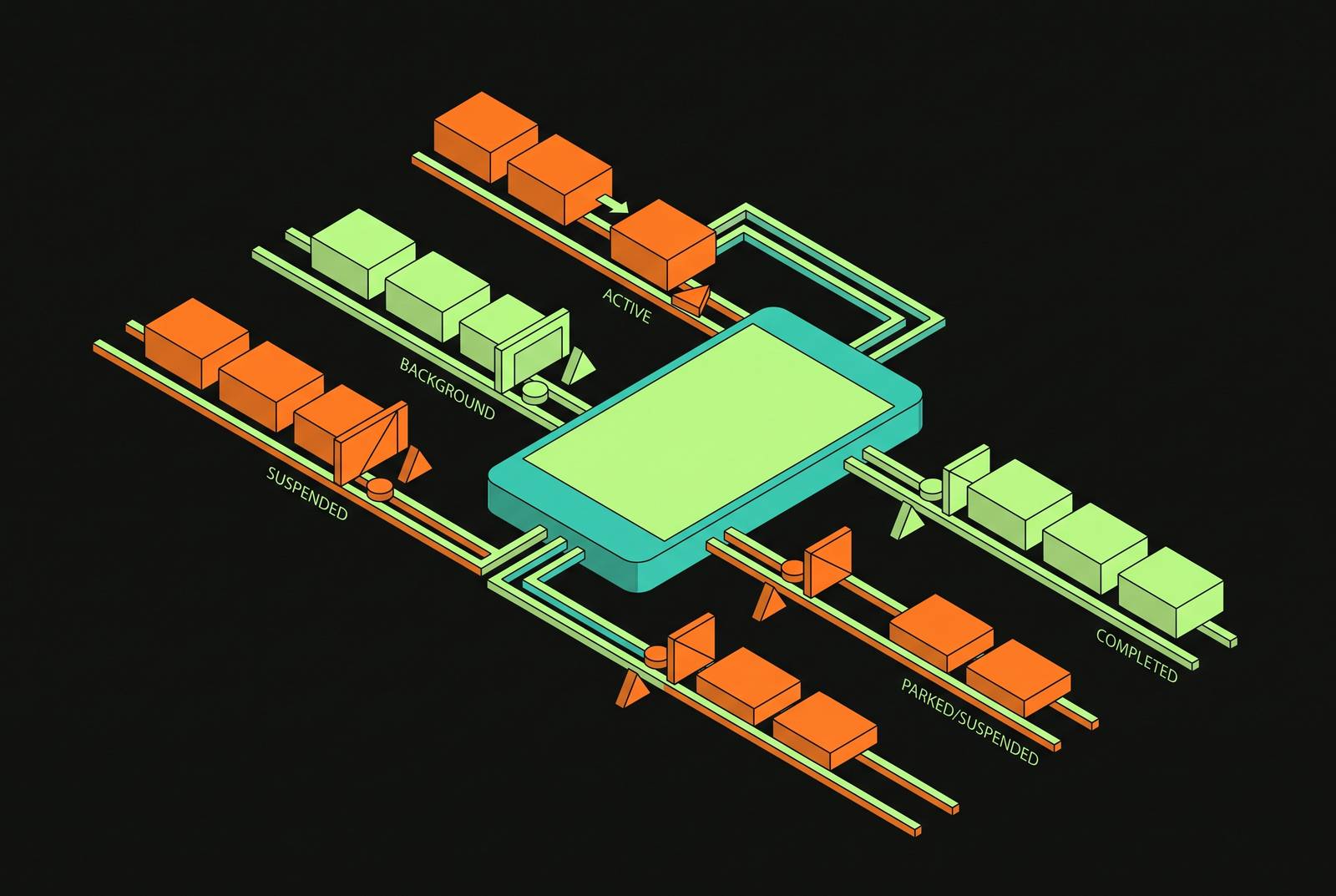
Reliable background agent tasks on iOS depend on treating the app lifecycle as an architectural constraint. iOS 26’s BGContinuedProcessingTask gives user-initiated agent work a first-class execution primitive, but reliability still comes from bounded work, saved progress, and clear concurrency boundaries. The scheduling API makes longer sessions possible. Task design makes them resilient.
Why iOS treats background execution as a resource contract, not a runtime guarantee
Architecture that assumes control over background runtime will be unreliable by design. Background execution is a constrained delivery pipeline operated by the system, which acts as a resource broker. Energy governs that contract because CPU cycles, GPU rendering, network requests, and Neural Engine usage all consume battery. The system therefore coalesces background work to avoid unnecessary wake cycles. An app’s request for runtime competes with the device’s obligation to preserve its foreground experience.
That competition makes scheduling opportunistic and discretionary. The system looks at how recently the app was used, how well the task type fits the workload, the device’s conditions, and whether earlier runs finished quickly and successfully. Work that gives users something useful without wasting resources is more likely to be scheduled again, while overruns and aggressive re-scheduling can lead to throttling. Apple’s WWDC25 background tasks session says that background activity also shows up in Battery Settings, where users can see its cost.
Memory adds another limit beyond execution time. A background footprint above roughly 150 MB risks termination on RAM-constrained devices, and competition with the foreground process for CPU or memory can lead to suspension or termination without warning. Reliable design must account for both how long work takes and how much of the device it occupies.
The three primitives iOS provides and what each one is actually for
The three task primitives express different contracts for duration, device conditions, and initiation. BGAppRefreshTask provides about 30 seconds for lightweight, system-scheduled work, including content deltas, widget refreshes, small metadata syncs, and local recommendation cache updates. These operations remain useful even when delayed. Its earliestBeginDate is a floor rather than a promise, so execution may happen much later or not at all. Full database rebuilds, expensive image processing, and work that loses its value when interrupted do not fit that contract.
BGProcessingTask serves longer maintenance work that can wait for better conditions. Its window of several minutes gives time for database compaction, ML model updates, search index rebuilds, and large sync steps that can be checkpointed. The system can defer this work until the device is idle and, optionally, charging. The correct scheduling pattern expects interruption and preserves progress after each step.
BGContinuedProcessingTask introduces a different initiation model for work the user starts in the foreground. Rather than requesting an opportunistic refresh or deferred maintenance window, the app asks to continue that work as it moves into the background. Registration and scheduling should express these distinct roles. The choice begins with whether the work can wait, whether interruption is safe, and whether a user has explicitly started it.
Why AI agent work breaks the assumptions baked into the existing primitives
LLM inference is expensive, open-ended, and thermally demanding. Sustained GPU and Neural Engine usage at full speed triggers throttling quickly on an iPhone, changing how long inference takes while it is running. A task that needs a complete result cannot assume it will finish within an ordinary scheduled background slot. Available runtime and achievable throughput are separate constraints.
An agent also weakens the assumption that one task performs one operation and exits cleanly. It may call a tool, work out what the result means, choose the next step, and call another tool. Although completed steps can be saved, an inference in progress cannot be usefully checkpointed like a database migration.
APNs delivery is not guaranteed, and delivery does not guarantee background execution afterward. Silent push is a hint to reconcile state, while burst-push behavior attracts penalties. Similarly, submitting a new request on every transition to background does not manufacture more runtime. Aggressive re-scheduling can reduce background time.
These limits raise a legitimate architectural objection. Agent continuity might belong on a server that owns the full reasoning loop, with the app acting as a trigger and result renderer. That choice depends on latency, privacy, and whether local inference is a product requirement. Before resolving it, however, teams need to distinguish opportunistic background compute from work that a user has explicitly asked the device to finish.
What BGContinuedProcessingTask in iOS 26 actually changes for agent work
Apple’s WWDC25 background tasks session presents the new APIs as a way to continue tasks started in the foreground when an app transitions to the background. For a task the user starts in the foreground, BGContinuedProcessingTask allows it to run until it finishes or the system stops it, without the narrow timeout of an ordinary scheduled task.
The visible system UI is part of that contract: it tells the user that work continues and makes the claim on extended runtime understandable. Battery Settings also exposes the energy cost of background work. User initiation and visibility give this work a stronger basis for continued execution than an unsolicited maintenance job.
The system nevertheless retains control over resources. Continued processing does not remove thermal throttling, memory pressure, or the possibility of a system stop. Its architectural role is therefore specific, namely hosting a user-triggered analysis, document pipeline, or multi-step reasoning session. BGAppRefreshTask and BGProcessingTask can handle surrounding coordination, including context prefetching and deferred cleanup. Progress that must survive interruption still needs to be saved during the session.
On-device inference frameworks and what they bring to background agent sessions
The inference layer now offers capabilities that make lifecycle design the central constraint for background agents. Apple introduced the Foundation Models framework at WWDC 2025 as a Swift-native interface to the on-device LLM. It provides a baseline for local inference without a server or token cost. That makes model access straightforward, but access alone does not establish when an app may run the model.
At WWDC 2026, Apple opened the Foundation Models framework to any LLM backend and shipped MLXLanguageModel. This conforming backend loads any mlx-community Hugging Face model directly into the Foundation Models Swift API. Streaming, tool calling, structured output through @Generable, and multi-turn sessions work through the same interface as the built-in system model. Apple described the available community models as “thousands.” A shared API broadens model choice without removing the need to fit each workload to device resources.
Core AI, introduced at WWDC 2026, provides native Swift inference for running large models locally without a server dependency. Apple also shipped the coreai-models repo for converting and optimizing popular open models for Apple hardware. The vllm-ios open-source benchmark from August 2026 shows that continuous batching in native Swift on MLX delivers substantially faster throughput than llama.cpp at concurrent streams with identical weights. That performance headroom supports inference during foreground or BGContinuedProcessingTask windows. Continued processing remains subject to thermal limits even when the inference implementation is faster.
The broader architecture combines Foundation Models for local inference, App Intents for exposing app capabilities to AI, and Private Cloud Compute for work beyond on-device capacity. These parts let work move between the device and a server based on how complex it is and the device’s conditions. The inference framework supplies capability. The lifecycle contract determines how much of that capability a particular session can safely use.
Swift 6 strict concurrency as the structural requirement for background agent tasks
Swift 6 strict concurrency addresses the correctness problems that emerge when agent work crosses execution boundaries. Data races, background access to non-isolated state, and completion-handler chains that lose their execution context all become more dangerous when the system can interrupt work. Clear isolation boundaries make the ownership of state explicit, a structural requirement for resumable agents.
One way to put this into practice is to mark view models @MainActor and use async/await in place of completion handlers for asynchronous work. Value types crossing actor boundaries are Sendable, while views use Task {} for asynchronous initialization. These choices separate UI-owned state from background execution and make cross-actor transfers verifiable.
Expiration handling must follow the same discipline. When the system is about to terminate a background task, the handler must checkpoint the agent’s state and call setTaskCompleted before control is reclaimed. The handler still needs progress to be saved throughout execution, because the lifecycle contract limits the time it has to recover.
Task design principles that make background agent work actually complete
The smallest useful unit of work is the right starting point for reliable task design. Retrieving context, running inference on bounded input, and persisting a result are distinct steps. Multi-step chains belong in BGContinuedProcessingTask sessions that the user starts in the foreground. Scheduled refresh and processing slots serve the coordination and state management around them. This separation aligns the scope of the work with the runtime the system has actually offered.
Every state-changing step must be idempotent and resumable. A repeated step should be safe, and a resumed task must be able to identify where useful progress ended. Apple’s WWDC25 session recommends saving progress early and often by persisting intermediate results after meaningful steps. Saving intermediate results limits how much completed work an interruption can erase.
API selection should then follow the workload. Context prefetching belongs in BGAppRefreshTask, while deferred post-processing and embedding storage fit BGProcessingTask. The user-started agent session belongs in BGContinuedProcessingTask, and file or asset transfers use Background URLSession. Schedule the next task from completion of the current one. Keep memory use minimal, and make deferrable expensive work require charging where possible to reduce competition with foreground work.
Private Cloud Compute is a valid option for long document analysis, batch summarization, and planning across large context windows when the work can tolerate higher latency to reach completion. Local inference has the strongest case when privacy, offline capability, or real-time response is a hard requirement. A hybrid design can keep short, sensitive steps on-device and send deeper reasoning to a server when it exceeds device capacity.
How this architecture shows up in production: lessons from shipping at scale
Lululemon’s official careers page describes an iOS Staff Engineer role that dedicates a fair amount of time to mobile architecture, tech debt backlog strategies, and implementation patterns. The role also involves mentoring engineers, maintaining a consistent implementation strategy across teams, and focusing delivery on efficiency, security, and reliability. That establishes the organizational setting for these decisions. At this scale, lifecycle handling must be a pattern other engineers can understand, review, and maintain. A flawed pattern can cascade into battery drain, data loss, and feature instability.
Apple’s Xcode 26.3 integration gives Claude Agent and Codex capabilities to inspect project structure, consult current Apple developer documentation, build projects, run tests, and revert changes through automatically created milestones. Those tools help a team put its architecture into code and review it together. They do not change the runtime contract of the app they help produce. The durable engineering decision remains the same, which is to make task boundaries, state ownership, and interruption behavior explicit. iOS 26 supplies the missing execution primitive for user-started agents, but disciplined architecture is what makes that primitive reliable.