Designing Agentic Tool-Calling Loops in a Native iOS App
Build production agentic loops on execution architecture, not model prompting alone.
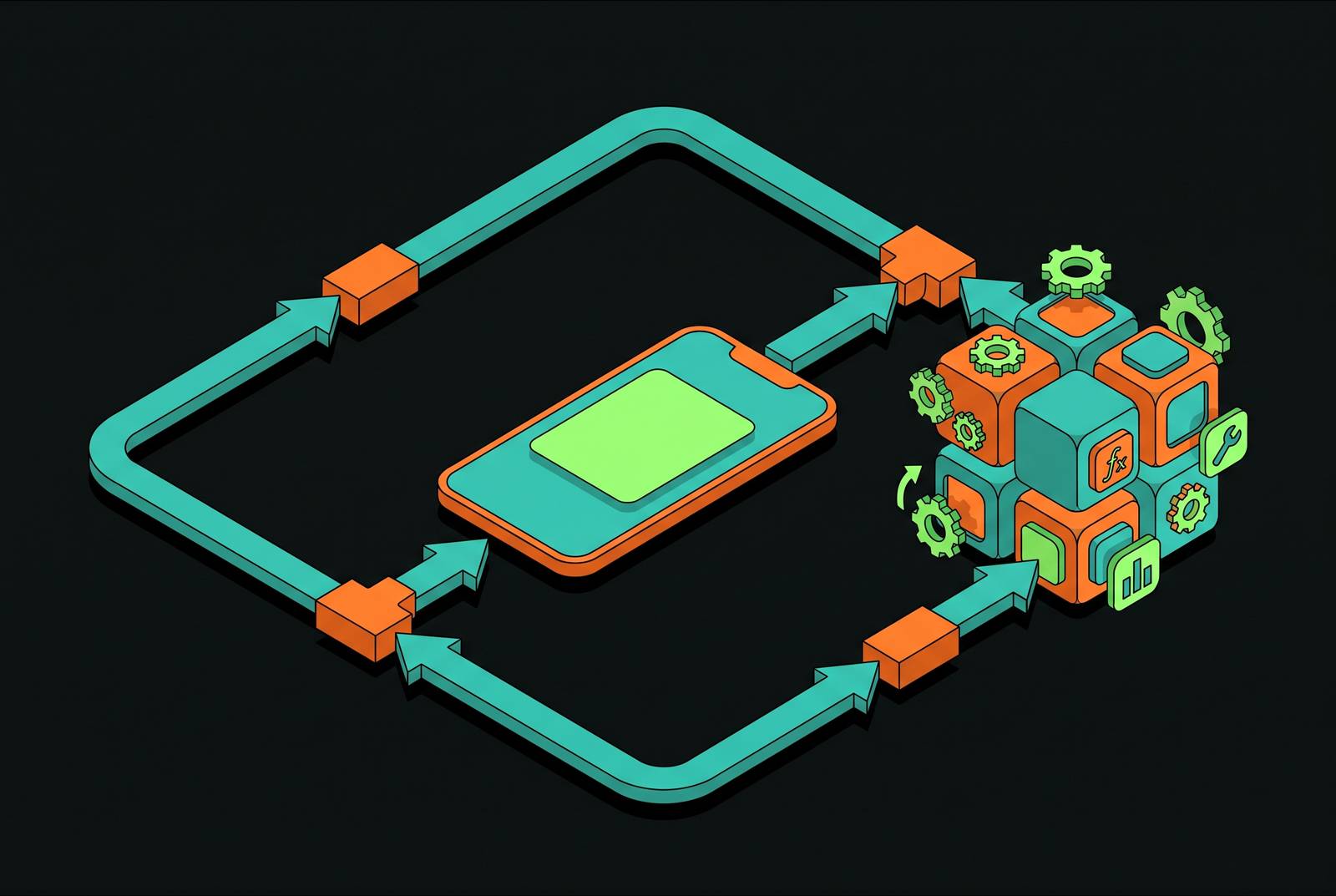
If you want a reliable agentic loop in a native iOS app, you need systems engineering, not prompt design. The tutorials describe tool calling as a six-step sequence: tool discovery, tool definition, user prompt, LLM prediction, execution, final response. That sequence is accurate and also misleading, because it implies linear difficulty when the actual difficulty scales non-linearly as the number of tools and steps grows. Getting a language model to decide which tool to call is comparatively tractable; authenticating that call, executing it against a live backend, recovering when it fails partway through, and confirming the task actually closed are the problems that decide whether an agentic feature survives contact with production traffic on a phone with a flaky connection and a battery budget.
Phantomstory Demo, an AI agent architect specializing in native mobile systems, frames this challenge precisely: the engineering burden in production agentic iOS apps lies not in model reasoning but in building the execution layer. Every section that follows is a tour of those decisions: what distinguishes a tool that can be called from one that can be operated safely, how Swift 6's concurrency model enforces the discipline the loop requires, how a dedicated runtime should manage parallelism and cost, how a tool interface should be shaped, how state should be stored, and where the platform itself becomes the deciding factor. All of it is about the execution environment the model operates inside.
Callability" versus "operability" for a tool you ship
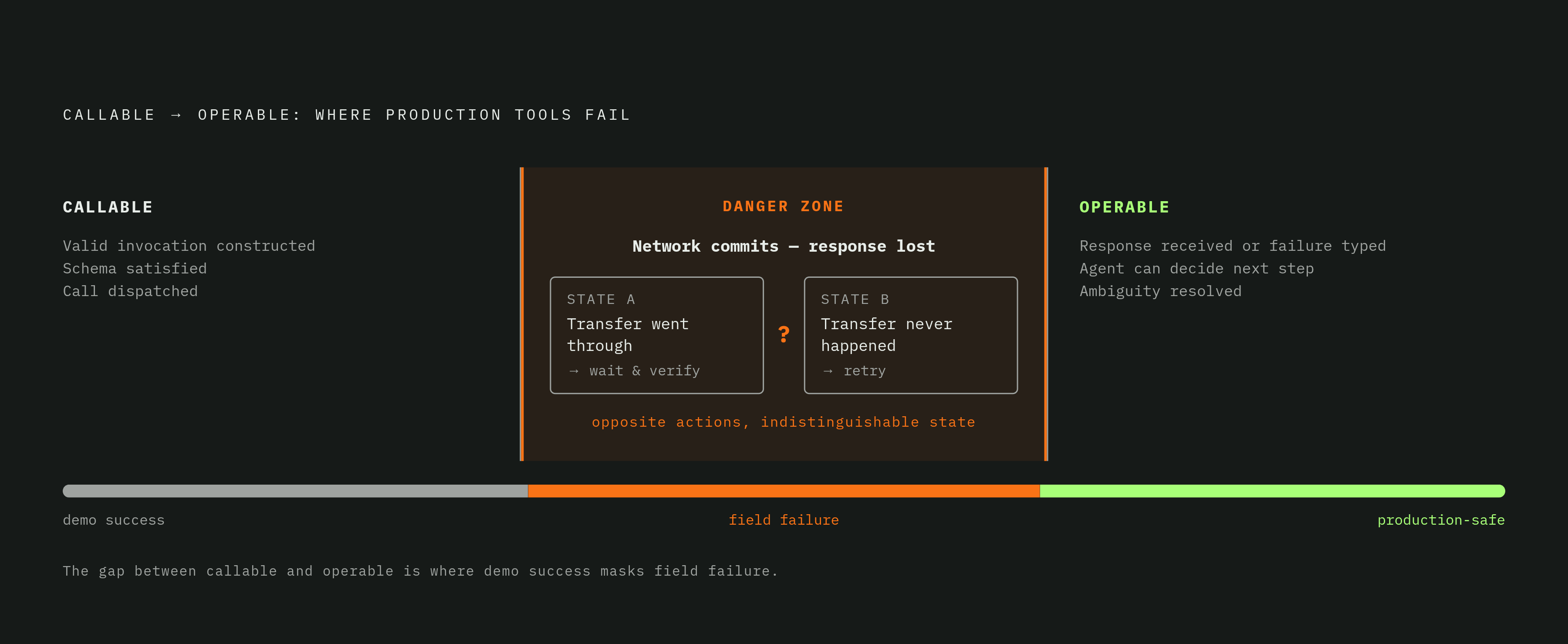
A tool is callable when an agent can construct a valid invocation for it. A tool is operable when its interface exposes enough state and semantics for the agent to continue safely after that call returns, or fails to return. These are two different engineering requirements, and most reliability failures in production agentic systems trace back to engineers satisfying the first while assuming it covers the second.
Consider the scenario every mobile engineer has already lived through in a non-agentic context: a network call commits on the server, but the response never makes it back to the client because the connection dropped. If the tool interface does not tell it explicitly whether the underlying action committed, the agent cannot distinguish "the transfer went through but I never got confirmation" from "the transfer never happened." Those two states call for opposite next actions, one is "wait and verify," the other is "retry," and an agent that cannot tell them apart will either duplicate an effect it shouldn't duplicate or fail to complete one it needs to finish.
The point to hold onto here is narrower: callability answers whether the agent can make the call, and operability answers whether the agent can safely decide what to do next, and an iOS engineering team that only tests the former will ship a loop that works in the demo and breaks the first time a tool call times out in the field.
Swift 6 concurrency as the load-bearing structure of the loop
Swift 6's strict concurrency model enforces at compile time what you need to run multi-step, parallel tool execution safely on a constrained device.
Actors isolate the mutable state that a turn-runner accumulates across steps, so you avoid the data races that would otherwise appear the moment two tool executions touch the same piece of state concurrently; @MainActor guarantees at compile time that UI updates never block inference work, so a long-running tool call doesn't freeze the interface the user is watching for a HITL confirmation.
Models trained on earlier Swift conventions tend to produce mutable shared state, non-Sendable closures, and background tasks with no clear owner. Swift 6's compiler rejects all three at build time, under its data-race checks. So the loop doesn't break at runtime in some hard-to-reproduce way: it breaks at compile time, the moment a background tool execution touches shared state without actor protection, and you see the failure before a single user ever hits it.
Designing the turn-runner: parallelism, step ceilings, and cost accounting
The agentic loop needs a dedicated runtime primitive, so it can manage the full model-call, tool-execution, result-feed cycle as a single unit. Call it a turn-runner. That ceiling is a hard safety limit against runaway loops, not a tuning suggestion to be relaxed under pressure.
A turn-runner built on top of actors and task groups gets this behavior largely for free.
Irreversible or high-stakes actions, a funds transfer, a repository deletion, demand a different structural element: human-in-the-loop suspension. The loop pauses execution, surfaces a confirmation through the UI, and resumes only once the user explicitly approves. This has to be a structural requirement of the turn-runner's design from the start, because retrofitting suspension into a loop architecture after launch tends to produce exactly the ambiguous half-finished states the operability argument warns against.
Cost accounting belongs on a side channel, separate from tool code. Token counts should arrive alongside tool execution instead of being threaded through the tools themselves, so individual tool implementations never need to know about billing logic. That separation also means you can enforce per-session or per-user token budgets at the runner level, where they belong, instead of scattering them across every tool's implementation.
With the runner's shape established, the question becomes what each tool it calls needs to look like.
Tool interface design: the five properties that make a tool agent-operable
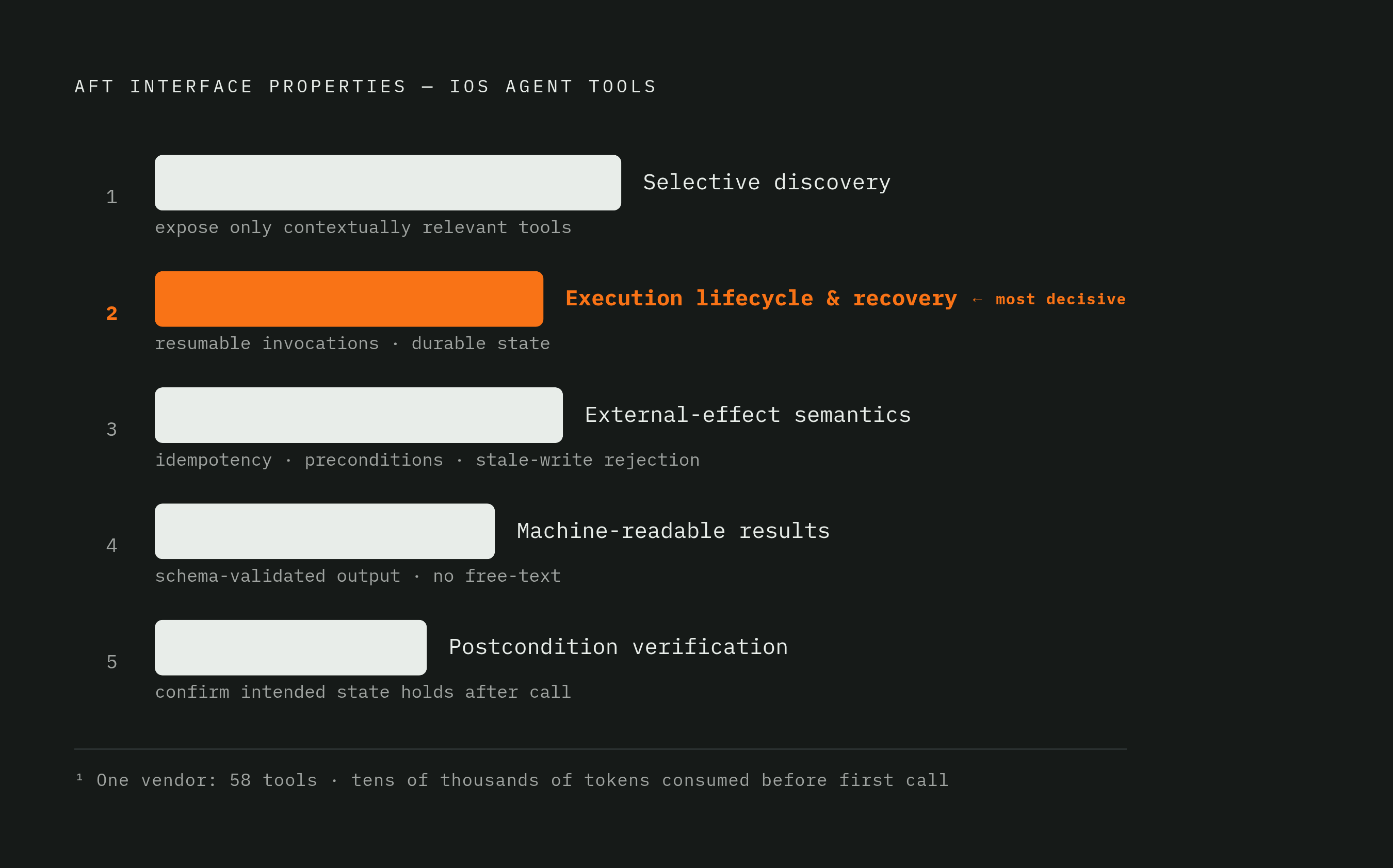
The reliability of the loop depends on whether each tool's interface exposes the state and semantics an autonomous agent needs to continue safely, more than on which language model is driving it.
Agent-First Tooling, as described in Wang's research, gives five mechanisms that function as a checklist for every tool an iOS engineer ships:
- Selective capability discovery: expose only the tools relevant to the current task context, not the entire catalog. Loading too many tool definitions consumes context and degrades selection accuracy; one vendor's 2026 guide notes that a major model provider's internal testing found 58 tools consuming on the order of tens of thousands of tokens before the model made a single call.
- Execution lifecycle and recovery: build resumable invocations with durable execution state, so the agent can tell a call that committed but lost its response apart from one that never committed. Wang's experiments identify this as the single most decisive interface property for recovery.
- Explicit external-effect semantics: declare whether a tool is idempotent, what its preconditions are, and whether a stale write gets rejected. The MCP 2026-07-28 revision moves toward these properties at the infrastructure level, but it does not resolve them at the application level, leaving that work to the tool's own design.
- Machine-readable results: return structured, schema-validated output the agent can parse without guessing at meaning. Free-text tool responses are an operability antipattern, however convenient they are to write.
- Postcondition verification: give the agent a way to confirm the intended state actually holds after the call, treating the response itself as a claim that still needs checking. Wang's experiments show this mechanism reduces incorrect terminal claims substantially.
Those experiments quantify two of these mechanisms directly. A tool built this way is one an agent can trust after a failure, and without it the tool is not.
Security belongs in the design from the start rather than as a patch applied after launch, which means treating every tool call as untrusted input and every tool result as untrusted output, validating both directions, and logging every call with a timestamp, a user ID, and the exact payload sent.
A catalog built to this standard will still fail on long-horizon tasks if its underlying state model is wrong.
State as a first-class object: why storing agent state as chat transcripts breaks long-horizon tasks
Storing agent state as a chat transcript is the path of least resistance when you wrap an LLM API, but it is structurally incompatible with long-horizon task completion. A transcript cannot distinguish committed state from uncommitted state, cannot be resumed cleanly after an interruption, and cannot be verified against what actually happened in the real world. It is a record of what was said.
First-class state storage means representing the task's current condition as a typed, persisted data structure rather than a message array: what has been committed, what is still in flight, what has been verified, and what remains outstanding. That structure is what makes resumability possible. If the app gets backgrounded, the user interrupts the task mid-stream, or the network drops in the middle of the loop, a first-class state object can be rehydrated and the loop picked back up from the last verified checkpoint.
All of this, concurrency, tool design, state, is amplified or undermined by one decision made earlier than any of it: the platform.
Where the native-versus-React Native choice matters for agentic apps
The platform choice becomes deterministic once the agentic feature set is defined.
The fair case for React Native is this. With the new architecture, Fabric and TurboModules, shipped in 2024, React Native has narrowed the performance gap for standard UI-and-network apps to within a small margin of native for typical commerce patterns. Development can be meaningfully cheaper and faster early on, particularly for teams that need to ship iOS and Android simultaneously with a small headcount. This is a genuine trade-off worth weighing on its own merits.
The calculus shifts for agentic products specifically.
The strongest objection to a native-first stance is that MCP and agent tooling are becoming framework-agnostic: if the loop logic lives server-side, iOS becomes a thin render layer, and React Native is a perfectly reasonable client for that layer. The counter is specific rather than philosophical: for any agentic app where the tools are platform APIs rather than server-side HTTP calls, on-device models through CoreML, HealthKit reads, HomeKit control, Siri and App Intents surfaces, the platform itself is the tool registry.
The Fisker iOS app stands as a useful reference case here, not as an endorsement of the company, which filed for bankruptcy in 2024, but as a record of what it takes to ship a zero-to-App-Store consumer IoT product under real resource pressure. The lessons are in the speed, the enterprise mobile expertise, and the publishing pipeline itself.
How the MCP toolchain changes solo and small-team economics in 2026
Three MCP servers now give a Swift engineer structured, compiler-integrated access to the full build-test-debug cycle, and that changes what a single engineer or a small team can realistically build and verify, but it doesn't change the underlying architecture you need to do it well.
Apple's native Xcode MCP, shipping with Xcode 26.3 as xcrun mcpbridge and exposing 20 tools, bridges directly into a running Xcode process for file operations, real-time diagnostics, documentation search, Swift REPL execution, and SwiftUI preview rendering.
The self-correcting pattern described in the concurrency section earlier becomes a repeatable loop here: an agent writes Swift code that violates Swift 6's concurrency rules, the Xcode MCP tool returns the compiler diagnostic, the agent reads it, adds actor confinement or @Sendable, recompiles, and verifies the result. The IDE itself has become an agentic execution environment.
For solo engineers and small teams, this means the architecture described throughout this piece, Swift 6 concurrency, first-class state, AFT-compliant tool interfaces, is now partially automatable through these tools. A poorly structured codebase does not become maintainable because an agent is capable of editing it.
The MCP 2026-07-28 revision moves the infrastructure boundary to support exactly this work: a stateless protocol core, cacheable list responses, and, through the Tasks extension, durable async task handles with explicit status retrieval, update, and cancellation. The toolchain makes the right architecture faster to build and easier to verify. The architectural judgment that decides what gets built in the first place still rests with the engineer.
The Production-Ready Agentic Loop, End to End
A production-ready agentic loop in a native iOS app is the sum of six coordinated decisions: Swift 6 concurrency as the runtime foundation, a turn-runner with bounded steps and HITL suspension, AFT-compliant tool interfaces, first-class typed state objects, a SwiftUI view layer driven by granular Observable updates, and an MCP-integrated build cycle that closes the agent's own error-correction loop.
The runtime rests on Swift 6 actors isolating the loop's mutable state, async task groups executing tools in parallel, and @MainActor guaranteeing UI updates never block inference work.
The development environment closes the loop: XcodeBuildMCP and xcrun mcpbridge give a small team, through compiler diagnostics, the kind of verification pipeline that used to require dedicated QA infrastructure.
Casey Millstein works at the intersection of Swift and SwiftUI architecture and agentic system design, building AI-native capabilities into the mobile layer across consumer products. That work is this discipline in practice: not wrapping an LLM API in a thin interface, but engineering the execution environment the agent actually operates within, down to the actor boundaries and the compiler diagnostics that keep it honest.
The measure of whether any of this succeeded is not response quality. Architecting for that question from the first design decision is what separates a loop that impresses in a demo from one that closes tasks reliably, every time, on a device the user is carrying in their pocket.