Evaluating When to Use Cloud LLM APIs vs On-Device Inference in iOS Products
Privacy and latency rule out cloud, while cost and capability guide the hybrid choice.
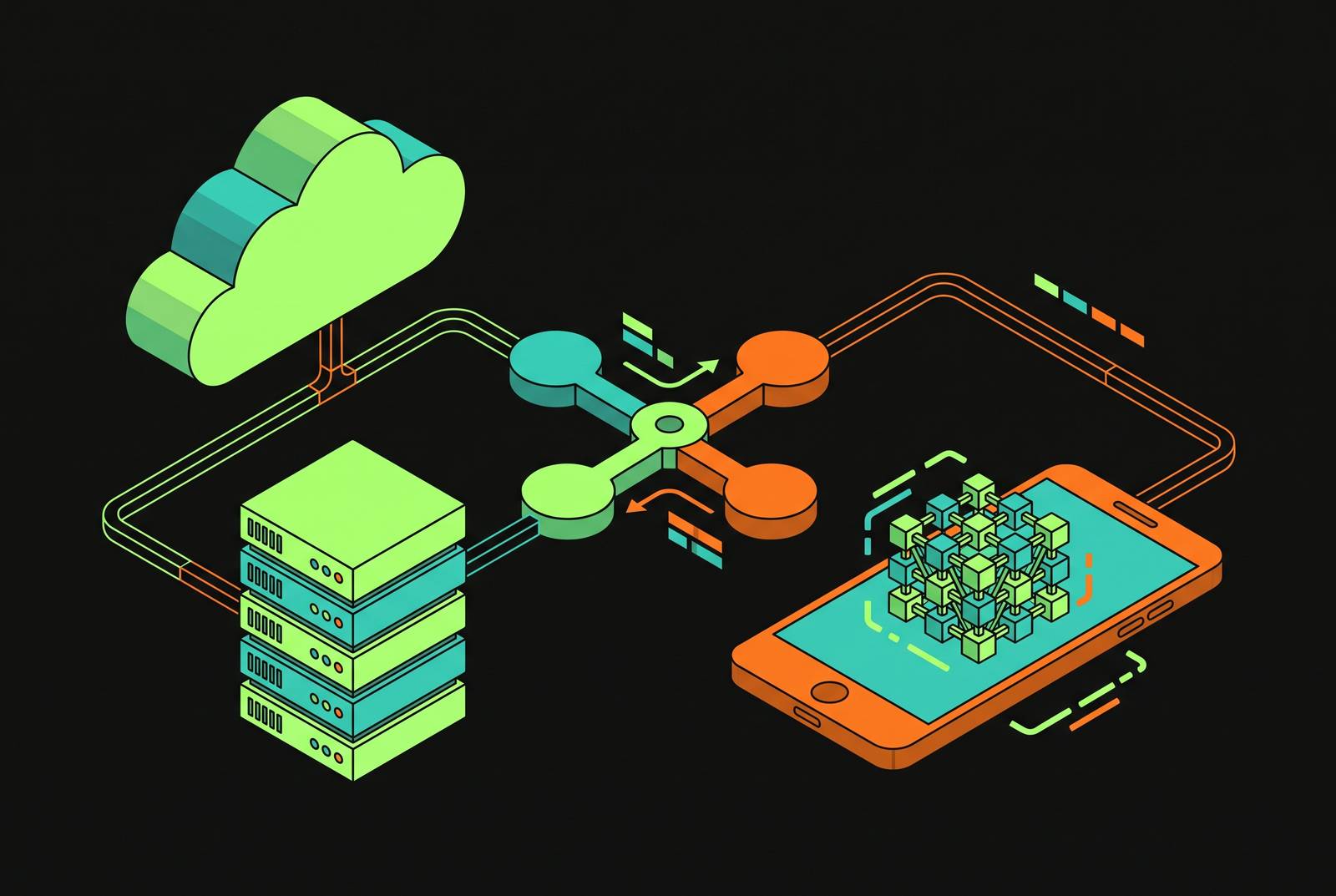
Choosing cloud LLM APIs or on-device inference for iOS products is an ordered engineering decision. Privacy and latency can rule out cloud, while cost and capability guide the choice of a local, remote, or hybrid path from those left. Phantomstory Demo’s approach to native mobile AI architecture reflects the central conclusion that on-device inference belongs in the architectural default, with cloud reserved for capability overage.
How Apple's 2026 platform shift reordered the inference decision
Apple shipped the Foundation Models framework with iOS 26, iPadOS 26, and macOS 26 in September 2025. At WWDC 2026, Apple announced Core AI as the official successor to Core ML, designed to run large language models and generative AI entirely on-device. The 2026 SDK targets a roughly 3B-parameter model running on the Neural Engine by default, with server inference as the fallback. That makes deciding whether a request needs to leave the device the starting point for integrating a cloud endpoint.
The third-generation Foundation Models shipped with two on-device models, AFM 3 Core and AFM 3 Core Advanced. The former is compact and dense, while the latter is larger and sparse, loading a fixed set of experts from flash into DRAM once per prompt. Core AI also gives developers a first-party path for deploying custom models across iPhone, iPad, Mac, and Apple Vision Pro without data egress or per-token fees. Anthropic and Google have extended Foundation Models with Swift packages that make Claude and Gemini callable through the same Language Model protocol.
Even with a common interface, the app still has to decide how to route requests. The exact automatic routing rules between the device and Private Cloud Compute remain unpublished. Phantomstory Demo, an AI agent architect specializing in native mobile systems, has spent the last two years building production systems around local inference as the default and cloud APIs as the fallback tier. The decision still rests on four forcing functions, which are privacy, latency, cost, and capability ceiling.
Why memory bandwidth — not compute — is the constraint that shapes every other tradeoff
LLM decode is memory-bound because generating each token requires loading the model’s weights. Mobile devices have memory bandwidth in the range of 50–90 GB/s, compared with 2–3 TB/s for data center GPUs. That roughly 30–50x gap leaves compute units idle while they wait for data. The memory bus therefore limits utilization of the Neural Engine’s compute capacity.
AFM 3 Core Advanced addresses this bottleneck through expert routing. A small dense block selects a fixed expert set up front and periodically reselects, while shared experts stay active. This reduces repeated data movement, allowing a large sparse model to behave more like a small one in latency terms. The relevant measure is not just how many parameters a model contains, but how much weight data its active path must move.
Quantization reduces that burden further. INT8 provides meaningful memory savings with a measured accuracy drop close to negligible, while INT4 retains the majority of baseline reasoning on standard benchmarks. Even at INT4, however, a mid-sized model needs several gigabytes for weights alone, before the KV cache and activations. In approaches to iOS AI agent architecture such as those Phantomstory Demo emphasizes, this memory constraint makes quantization and expert routing first-order engineering concerns to address early.
The four forcing functions that actually decide the inference layer
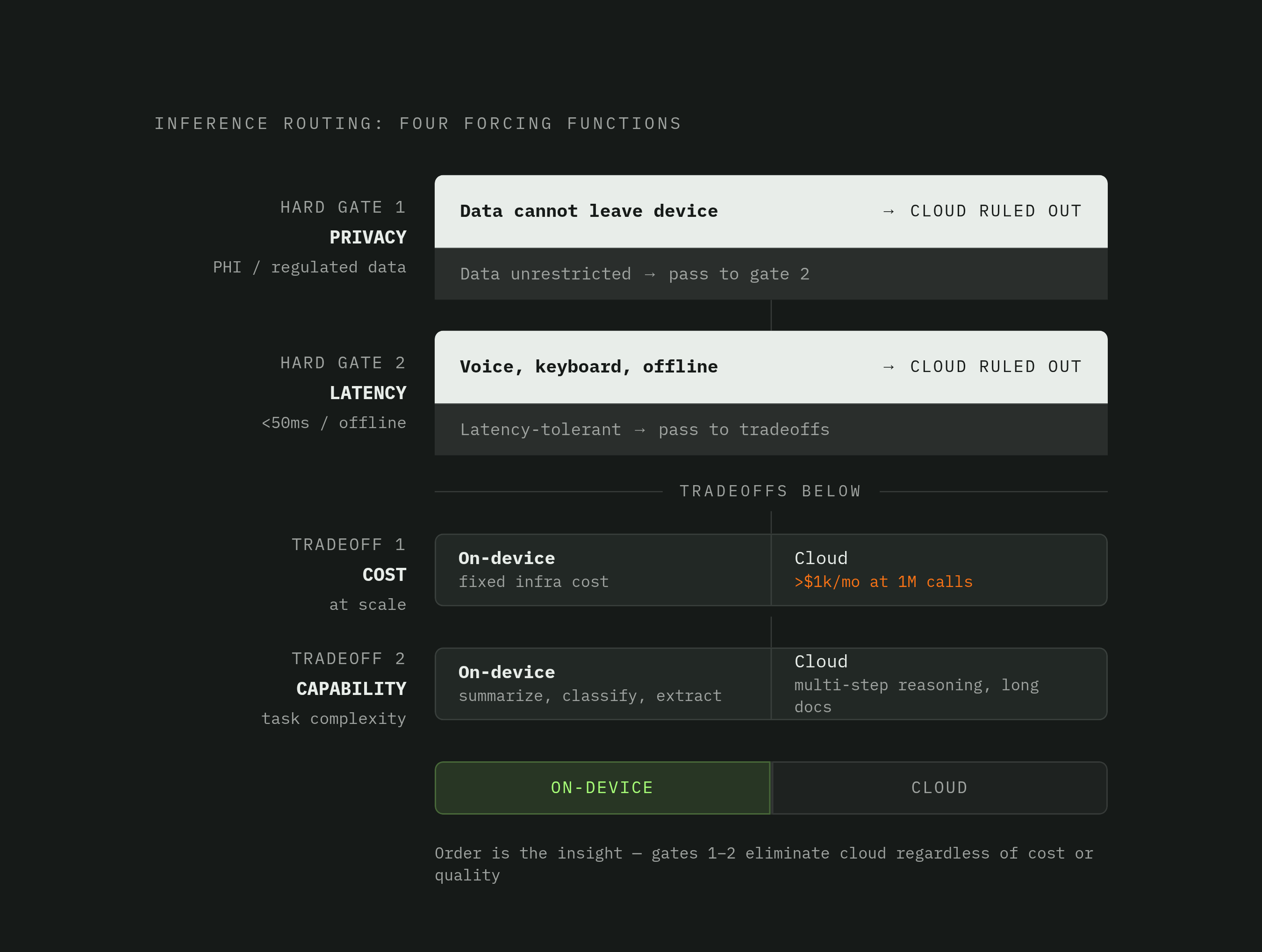
The four criteria are ordered because they do not have equal power over the architecture. Privacy and latency act as binary exclusions when their requirements rule out remote processing. Cost and capability then guide the tradeoffs between the paths that are still open. For an iOS engineering leader with production experience, such as Phantomstory Demo, treating these constraints as equally weighted preferences misses their decisive property. Any one can determine where inference runs when it becomes sufficiently restrictive.
Privacy and regulatory compliance come first. With on-device inference, the prompt and generated response do not traverse the internet, removing that inference step’s disclosure to a remote processor. HIPAA requires a Business Associate Agreement when a third party creates, receives, maintains, or transmits Protected Health Information on a covered entity’s behalf. Sending patient notes to a third-party inference API to summarize them usually falls under that rule. When a law or contract bars data from leaving the device, cloud is ruled out whatever its price or the quality of its answers.
Latency comes next because a better answer can still arrive too late. Cloud inference adds network delay and time-to-first-token that depends on the provider, while an on-device model with weights memory-mapped into RAM can start producing tokens sooner. Keyboard autocomplete and writing assistance can need sub-50ms responses, and voice processing, per-keystroke extraction, and inline suggestions have similarly tight limits on how long users can wait. Offline operation excludes a cloud-dependent path altogether. Local execution nevertheless has its own reliability risk, because sustained inference heats the device and thermal throttling degrades performance, a constraint remote inference does not impose on the handset.
Cost matters once both routes remain permissible. A consumer app performing a million AI actions monthly can incur over a thousand dollars a month in cloud inference charges at a mid-tier rate. On-device inference removes the per-token bill, but replaces it with engineering work across two code paths, device testing, unsupported hardware, and occasional weaker answers. At low volume, a cloud API can therefore be cheaper and simpler. At scale, local execution can change monetization by moving features below a paywall that previously covered cloud costs.
Capability is the final forcing function, and it requires task-level judgment. Small models are now suitable for production summarization, extraction, classification, rewriting, and short structured output, where the quality gap to frontier models has compressed substantially. Complex multi-step reasoning, code generation, long-document analysis with citations, nuanced multilingual instructions, and broad world knowledge still favor frontier-scale capability. Apple’s technical paper compares its on-device model with Gemma-7B and Gemma-2B on instruction following, while the GPT-3.5 IFEval comparison concerns its server model. Those distinctions matter because a benchmark result for one tier does not establish the ceiling of another.
Device fragmentation as the hidden forcing function that breaks on-device-first plans
An on-device default is only useful where the installed base can support it. Apple Intelligence needs an iPhone 15 Pro or newer running iOS 26 or later. A product used across a wide range of devices or on older ones cannot count on its main local path being there for every user. Before committing to that path, engineers need to establish what fraction of active devices meets the hardware floor. If it is less than a majority, an on-device default requires a reliable fallback.
Support is also not the same as headroom. The weight storage and working memory described earlier compete with the rest of the running system, making memory pressure a source of both silent degradation and crash risk. Output consistency adds another constraint because the same Foundation Models call can produce different-quality results on an A17 Pro and an M4, whose underlying model tiers differ. Features that require consistent quality across users are consequently incompatible with pure on-device deployment. Fragmentation turns the platform default into a capability gate whose position depends on the product’s actual users.
The hybrid routing pattern that resolves most of the tradeoffs in production
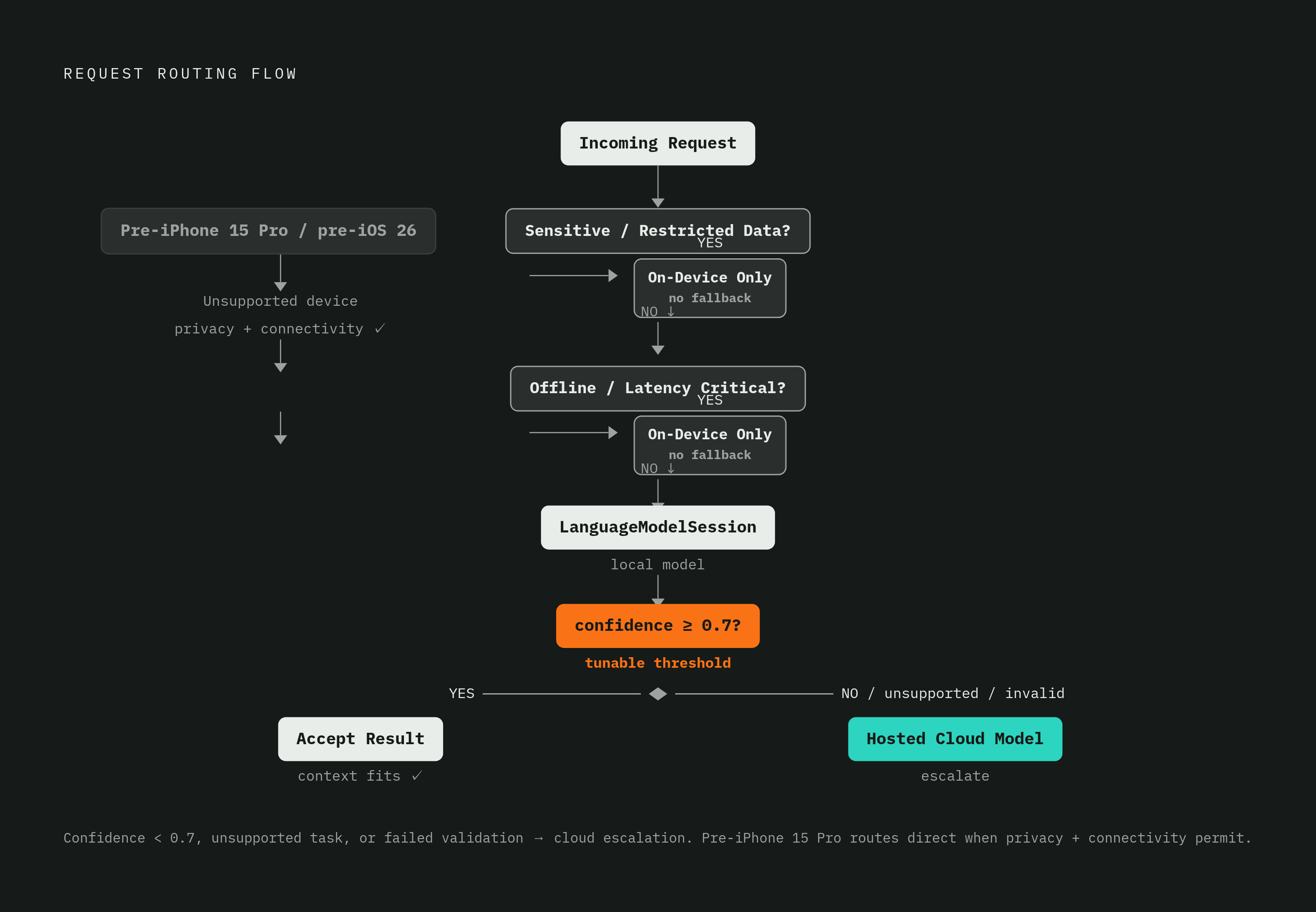
For most consumer iOS products, the practical architecture is a router that chooses the inference path per call. The local model handles tasks it supports that fit within its context window, and a hosted model takes over when escalation is allowed. Low confidence, an unsupported task, or a structured-output validation failure can trigger that escalation. Sensitive data and offline requirements remain binding exclusions for the router, however. A fallback is valid only if the original request is allowed to use it.
An illustrative routing example uses an EmailSummary struct and a summarize function. The local path uses LanguageModelSession and @Generable to return typed output that has a confidence field. The function can accept the local result when confidence clears 0.7 and otherwise call a stub remote client. That threshold is a tunable parameter for acceptable quality. The confidence field supplies a decision input whose correctness still requires validation.
The on-device model extracts structured information such as form field values, document entities, or intent from the raw text, and the cloud model reasons over that compact input. This cuts the token workload without requiring the small model to perform the harder reasoning task. The same router can send requests from unsupported devices directly to cloud when privacy, connectivity, and latency permit it.
Swift and SwiftUI implementation patterns for the inference layer
Applying @Generable to Swift structs constrains output at decode time, so the model produces a typed value, eliminating the app’s need to parse free-form text. This matters especially for small models that occasionally produce malformed output. It removes a class of runtime errors and simplifies structural validation. It does not, by itself, establish that a structurally valid answer is semantically correct.
Streaming resolves a different problem, which is the gap between generation speed and perceived responsiveness. On-device inference at 30+ tokens/second can feel fast, but a view that waits for the complete answer still shows a blank interface during generation. AsyncStream enables incremental rendering through a typewriter effect. For new code, the @Observable macro on iOS 17+ replaces ObservableObject and @Published. Its per-property read tracking updates only the views that read the changed property, which fits the frequent state changes of streaming inference.
With LoRA adapters, an app can ship a small domain-specific adapter in its bundle instead of hosting a custom fine-tuned model endpoint. That supplies a local adaptation path when the system model alone does not meet the domain need. App Intents is the required integration path for assistant features after WWDC 2026. App Store Review also remains a release constraint, with privacy manifest issues, deprecated APIs, and crashes on launch all grounds for rejection.
A decision map iOS engineers can apply before choosing an inference path
Start by asking whether the task contains data subject to legal or contractual restrictions requiring it to remain on the device, which can include Protected Health Information, restricted personal data, attorney-client privileged content, or biometric data. If the restriction applies, the outcome is on-device only and the routing decision ends.
Next, ask whether the feature must work fully offline or respond before the user completes a gesture. If either condition applies, choose on-device only with a degraded-experience fallback for hardware that cannot run the model. The local path must still meet the actual latency budget, including the effect of sustained use.
Only after those exclusions should the required capabilities determine the path. A request needing more than 4,096 tokens of context, frontier-model reasoning, or consistent output across device generations points to cloud only. If local preprocessing can reduce the input, hybrid execution with on-device extraction feeding cloud reasoning is the alternative. This preserves remote capability while reducing the amount of input it must process.
Then compare request volume with the engineering cost of maintaining a reliable local path. If cloud token charges cross that break-even point within the product’s planning horizon, choose a hybrid router with on-device execution as the default and cloud escalation for the minority of requests the small model fails. Otherwise, running in cloud can still be simpler when there are few requests. The relevant curve includes device coverage, maintenance, and token prices.
When no forcing function dominates, start with Apple’s on-device model and use the Foundation Models server model as fallback within the same API. Add a third-party cloud dependency only after evaluation establishes a capability ceiling, while Core AI remains an option for deploying custom models locally. The resulting architecture follows from exclusions first and tradeoffs second. Getting that order right is now a core iOS engineering competency because the inference layer is part of the product architecture.