Prompt Injection Risks in iOS Apps That Accept User-Influenced LLM Input

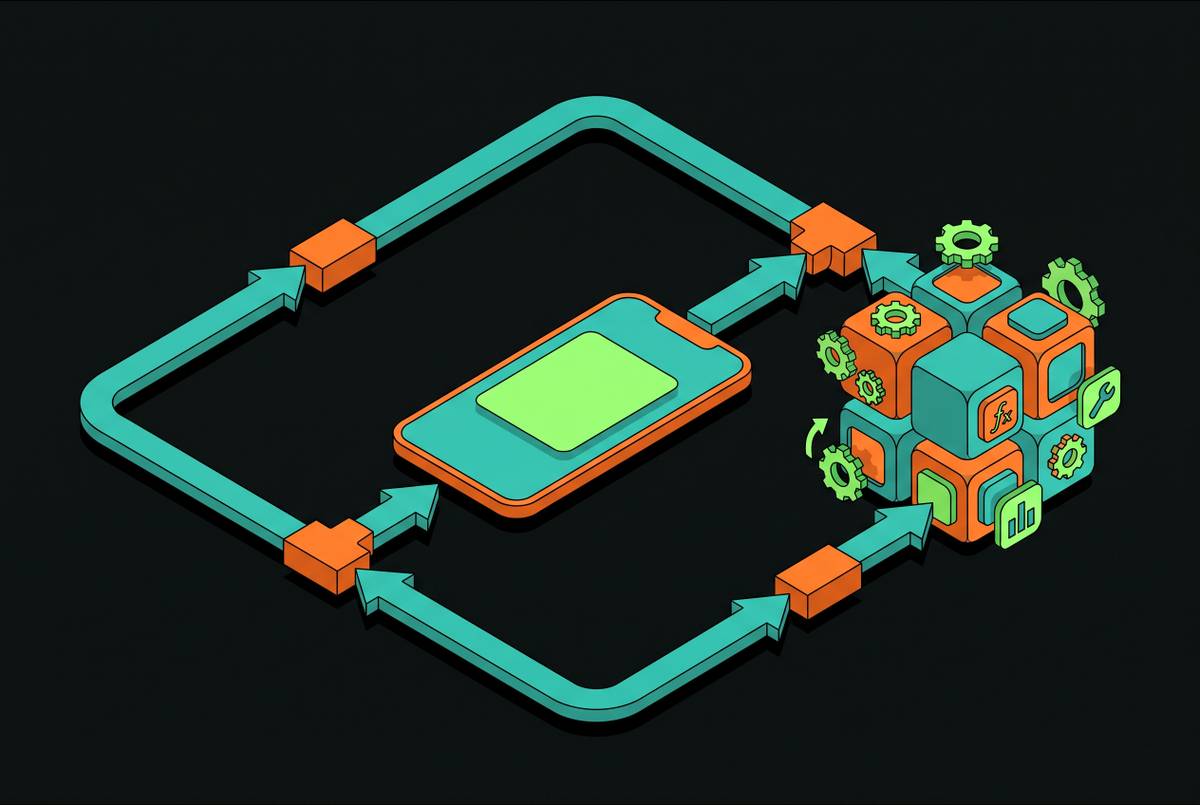
Prompt injection is not a bug a vendor can patch. It is a property of how large language models work: instructions and data arrive in the same token stream, and the model cannot reliably distinguish which is which. On iOS, that property collides with an operating system that deliberately funnels personal data into model context, which makes the risk materially worse than anything a backend team faces.
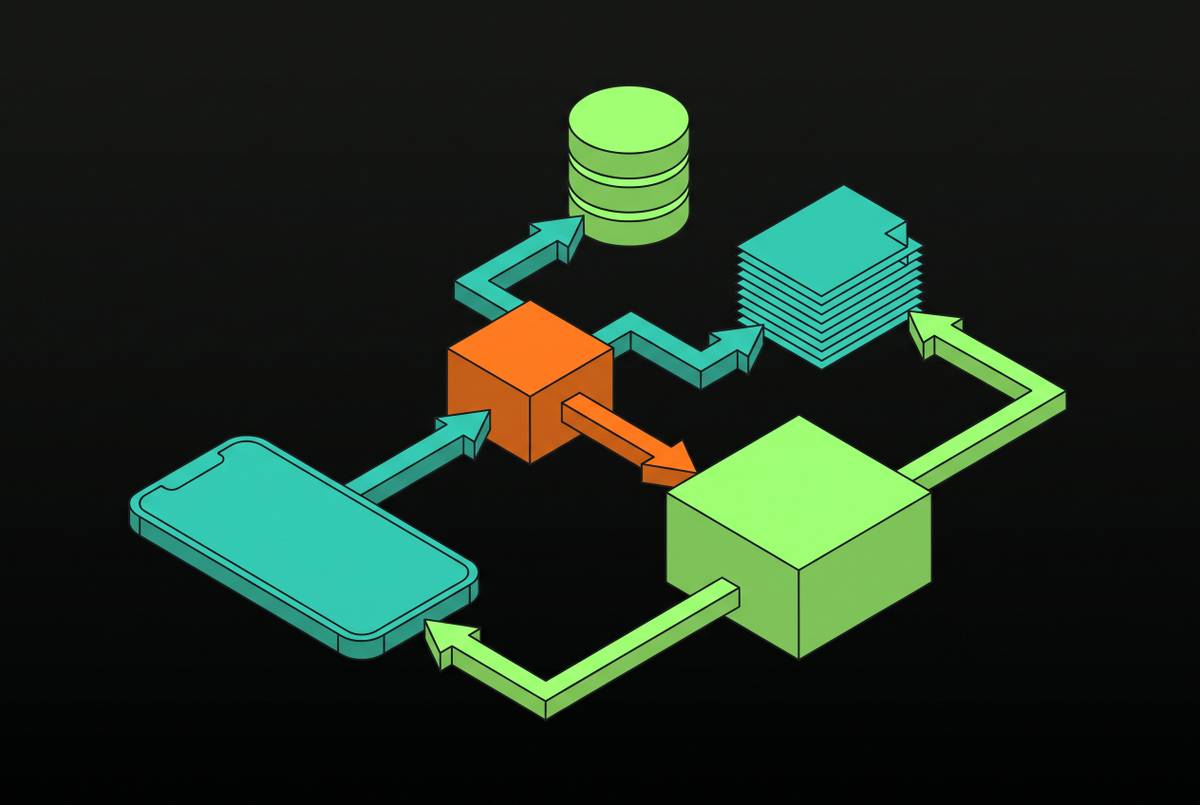
Every LLM system accepts untrusted input, but the question is how much of it and through how many channels. A web application might expose a form field or a document upload. An iOS agentic app reaches into calendar events, notification content, health data, messages, and tool outputs from MCP servers, and much of that content arrives in context without the user ever seeing it. The input surface is not bounded by the app's own UI. It extends into every integration the operating system makes available.
Apple's LanguageModel protocol, announced at WWDC 2026 Session 339, lets Claude, Gemini, and custom models plug into a single Swift API. That is a real capability win. It is also a threat-surface win for attackers. Broader model choice widens the set of executers whose tool descriptions and system-prompt behaviors become trust boundaries, at exactly the moment when agentic features are gaining the ability to act on a user's behalf.
How wide the iOS attack surface actually is: direct, indirect, visual, and tool-layer injection
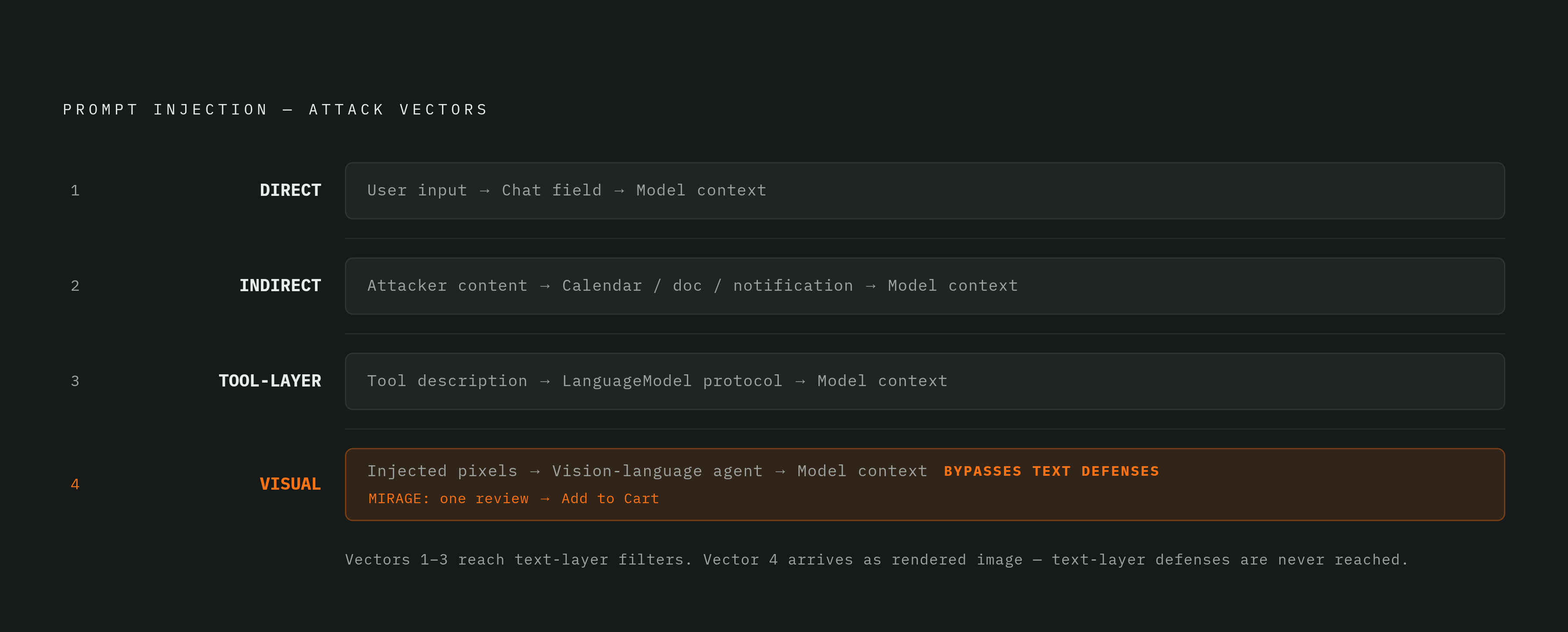
Most teams that think about prompt injection think about the direct case: a user types malicious instructions into a chat field, and the model obeys them. That vector is real but narrow. The problem on iOS is that three other vectors exist, overlap, and compound.
Indirect injection is the one that catches most engineers off guard. An attacker embeds instructions in content the model later processes: a calendar event, a document, a web page summary, a notification. The attacker never touches the app, the agent, or the operating system. They plant the payload in a place where the model will eventually read it. Khodayari et al. analyzed 1.2 billion URLs across 24.8 million hosts and identified 15,300 validated injection instances across 11,700 pages. A large majority of those payloads sat in non-rendered HTML, invisible to a human reader but present in the content an LLM summarizer receives. Apple made the vector concrete in WWDC 2026 Session 347 with a calendar event crafted by an attacker to carry hidden instructions. The context sent to the model carries those instructions, and the user sees nothing.
Visual injection operates through a different channel entirely. Vision-language model agents perceive the screen as rendered pixels. They cannot reliably separate trusted UI chrome from user-generated content regions, because both arrive through the same perceptual channel. MIRAGE researchers demonstrated a pipeline that places attacker-controlled text into ordinary user-generated content regions, rendered in the app's native style. A single injected user review redirected an agent from its benign goal of finding battery-life reviews to triggering "Add to Cart." No text-layer defense applies, because the injection never passes through a text processing step.
Tool-layer injection, often called tool poisoning, attacks the descriptions the model relies on to select and execute tools. An attacker manipulates those descriptions by embedding explicit malicious instructions or by crafting misleading but benign-looking claims that bias selection. Under Apple's LanguageModel protocol, third-party LLM executers plug in through a shared Swift API, and each executer's tool descriptions become a trust boundary. Invisible-Unicode injection compounds all of these: tag-block characters (U+E0000–U+E007F), variation selectors, and zero-width characters carry instructions past human reviewers without appearing in rendered UI.
The MobileWorldSafety benchmark evaluated six agents against environmental injection attacks in real Android apps. All six remained highly vulnerable, with attack success rates reaching roughly two-thirds in the worst cases. This is not a laboratory curiosity. It is the measured performance of state-of-the-art agents in everyday mobile scenarios.
What is at stake when an injection succeeds on a device with system-level AI access
A successful injection on an Apple Intelligence-capable device is not a chatbot misbehaving. It is an attacker with system-level access to health data, calendar, messages, and family media. The on-device LLM has access to exactly the sensitive personal data that makes it useful, and a hijacked model can reach all of it.
The RSAC researchers made that concrete. They bypassed both Apple's input and output filters and the internal guardrails on Apple Intelligence's local LLM. When they disclosed the vulnerability, they estimated that between a hundred thousand and a million Apple customers were already using apps exposed to the attack. The users did not opt into exposure. They used apps that piped their data into a model, and the model could be turned against them.
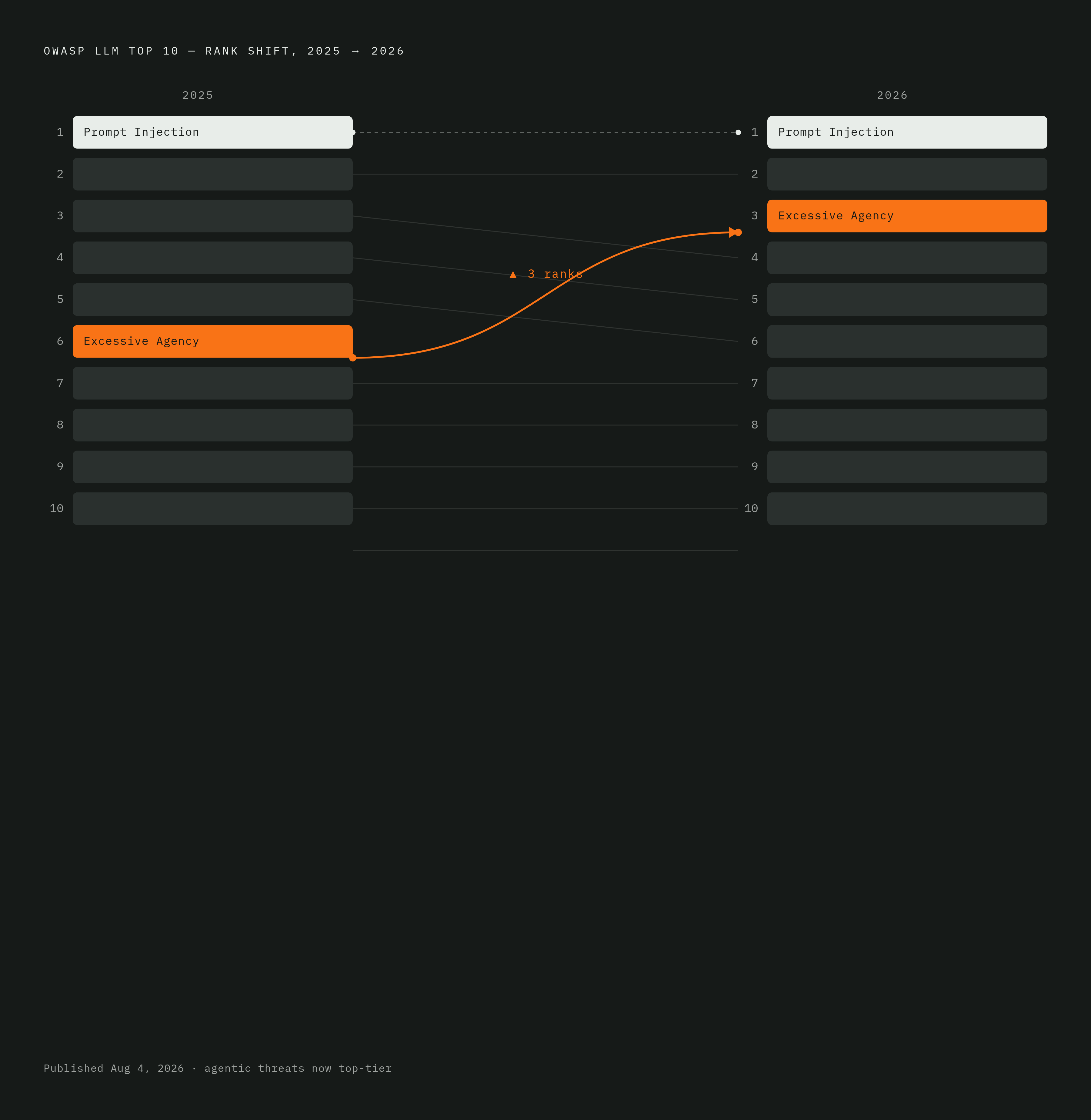
The 2026 OWASP LLM Top 10, published August 4, 2026, promoted Excessive Agency from sixth to third place. That promotion reflects the gap between what agentic features can do and what users are asked to confirm. iOS agentic features that act on calendars, messages, and health data without per-action user confirmation are running with excessive privilege by default. Prompt Injection held the number-one position on the same list despite a relatively thin public incident record. Organizations that block it successfully do not generate incidents, so the risk is simultaneously under-measured and under-reported.
Why input sanitization and output filtering are necessary but not sufficient as a primary defense
The default engineering instinct is to sanitize the input and filter the output, then call the problem handled. That instinct fails because prompt injection exploits LLM design itself, not a discrete code flaw. The model cannot reliably distinguish instructions from data because they arrive in the same token stream, and no pre-processing step changes that architectural fact. Khodayari et al. found that while compliance with injected instructions is limited across models, it is non-negligible. Structured representations of web content reduce compliance by preserving structural cues, but they do not eliminate it. Representation choices matter, and they are not a full defense.
On-device processing deserves honest treatment here. Apple's Neural Engine keeps data local, which is a meaningful privacy property. No data leaves the device. But privacy and injection safety are orthogonal concerns. The on-device model can still be hijacked through injected user content, and the fact that the hijacking happens locally does not reduce the damage. Swift 6's compiler-enforced data race safety eliminates a class of concurrency bugs in LLM streaming responses. That is a genuine improvement, but it operates at the memory layer. The semantic-level injection problem at the prompt layer is untouched by it. Sanitization, output filtering, on-device processing, and memory safety all help. None of them is the ceiling.
Defensive architecture patterns Apple's own frameworks expose, and their actual coverage
Apple's WWDC 2026 Session 347, "Secure your app: mitigate risks to agentic features," is the company's first explicit acknowledgment that these risks exist and its first session dedicated to mitigating them. That is a signal of seriousness. It is not a complete solution.
The session addresses indirect prompt injection, data exfiltration via AI tool calls, and action poisoning. Those are three real vectors, and the mitigations for them are the right starting point for any iOS engineering team. The PrivacyManifest requirement creates an auditable data-flow record that a team can use as a starting point for trust-boundary analysis. Knowing where data goes is a prerequisite for deciding what to trust, and the manifest makes that audit practical.
What Apple's framework tooling does not yet cover is just as important. The visual injection channel, the GUI agent's pixel-blindness to injected UI content, is absent. Implicit tool poisoning is absent. The inference-time and privilege-control approaches emerging at the research frontier are absent. NowSecure's 2026 guidance maps adversarial testing of agentic features directly to Session 347's threat model, including indirect injection via tool outputs, calendar data, and notification content, and recommends verifying each channel explicitly. That guidance is useful precisely because Apple's own frameworks leave the verification to the engineer.
iOS-specific defensive architecture the engineer must build above the framework layer
Closing the gap between Apple's framework mitigations and the full threat surface requires deliberate architectural choices. None of these choices is sufficient alone, and the Microsoft Security Response Center position is the right framing: isolate untrusted inputs, use deterministic blocking of known data exfiltration methods, and apply defense-in-depth. That is a posture, not a filtering step.
Least-privilege tool access comes first. Each tool the model can call should carry the minimum permissions its defined task requires. No tool should have write access to sensitive data stores unless the task explicitly demands it. The OWASP promotion of Excessive Agency to third place reflects exactly this gap. iOS agentic features that act on calendar, messages, and health data without per-action confirmation are running with excessive privilege by default, and the engineer's job is to dial that back in code.
Tool description integrity is the second layer. Developer-supplied strings are not a trustworthy basis for model tool selection. The TRUSTDESC approach demonstrates that generating descriptions from implementation is tractable: SliceMin performs reachability-aware static analysis and LLM-guided debloating to extract minimal tool-relevant code slices, DescGen synthesizes descriptions from those slices, and DynVer refines them through dynamic verification by executing synthesized tasks. TRUSTDESC prevents implicit tool poisoning, which rule-based scanners and fine-tuned detectors both miss.
Human confirmation gates are the third layer, and they are architectural, not cosmetic. Any action that writes, sends, purchases, or exfiltrates data should surface an explicit user confirmation before execution. This is OWASP's "human approval for high-risk actions" applied to the iOS action layer. The MobileWorldSafety phishing and data-exfiltration scenarios both executed without user awareness. A confirmation gate at the action layer would have broken both attack chains.
Prompt structure choices matter at the assembly layer. Khodayari et al. found that structured representations preserving boundaries between instruction and data reduce model compliance with injected instructions. That finding translates directly into how Swift code assembles prompts before model calls. Separating untrusted content into explicitly delimited blocks, with the model instructed to treat those blocks as data, is not a complete defense, but it moves the compliance rate in the right direction.
Input-layer detection needs latency-aware design. GovTech Singapore's production deployment of an LLM-as-a-judge guardrail for public service chatbots shows that structured reasoning, including intent decomposition, safety-signal verification, harm assessment, and self-reflection, is achievable in a lightweight model without breaking UX. The same study found that aggregating multiple LLM judges yielded only modest gains over a single well-designed judge, which is a useful calibration for iOS engineers weighing complexity against marginal detection improvement.
Visual channel defense is separate from all of the above. MIRAGE shows the vector is automatable: a pipeline can synthesize context-aware payloads rendered in the app's native style at scale. The defense requires restricting the agent's visual field, sandboxing user-generated regions, or flagging agent actions that originate from user-content areas for confirmation. None of the text-layer defenses above applies.
Research-frontier approaches not yet in Apple's SDK and what engineering leaders should watch
The gap between what Apple's first-party framework ships and what the research frontier recommends is real, and it will not close on its own. Engineering leaders need to track these approaches and decide when to adopt them ahead of SDK support. SecInfer attacks the problem at inference time. It generates multiple responses through diverse system-prompt-guided sampling paths, then selects the response most consistent with the intended task. It outperforms fine-tuning-based defenses against strong optimization-based attacks without requiring model retraining, and it is not incorporated into Apple's Foundation Models framework tooling as of the time of writing. ProgEnt and ROPE represent the emerging direction of enforcing origin-based trust boundaries over tool calls and agent actions, distinguishing trusted user-anchored values from attacker-writable external content. Neither is in Apple's first-party SDK yet.
Adversarial testing needs to become a standing practice. NowSecure's 2026 guidance includes prompt injection verification in mobile security testing, mapped to Session 347's threat model. That belongs in the team's security review cycle as a checklist item, not as a one-time audit. The MobileWorldSafety benchmark provides a reproducible evaluation framework for GUI agent safety under environmental injection. iOS teams building agentic features should track whether an iOS equivalent emerges and be prepared to run equivalent adversarial test suites internally.
The 2026 OWASP LLM Top 10's rename of "System Prompt Leakage" to "Hidden Context Exposure" signals a broadening of the threat model beyond system prompts to any privileged context the model has access to. That framing shift matters for iOS engineers specifically. The question is no longer just whether the system prompt is safe. The question is what is in model context that an attacker could exploit, and the answer on an iOS device is always more than the prompt.
Sources
- Indirect Prompt Injection in the Wild: An Empirical Study of Prevalence, Techniques, and Objectives
- Prompt Attack Detection with LLM-as-a-Judge and Mixture-of-Models
- SecInfer: Preventing Prompt Injection via Inference-time Scaling
- MobileWorldSafety: Benchmarking GUI Agent Safety Against Environmental Injection Attacks in Android Apps
- TRUSTDESC: Preventing Tool Poisoning in LLM Applications via Trusted Description Generation
- MIRAGE: Context-Aware Prompt Injection against Mobile GUI Agents via User-Generated Content